
FAQ
My DMs across my socials get flooded by people every single day. But a large portion of the questions I get are very repetitive. So I figured I should make a comprehensive FAQ about it. This’s the first iteration and I’ll keep updating it. I’ve also rephrased the questions to make them more comprehensive. Enjoy :)
- What’s the Dagmawi Babi Universe?
- How did you become a Christian?
- How do you manage your time?
- How are you so consistent in content creating?
- Software Engineering in the age of AI
- What AI tools do you use?
- What tech stack do you use?
- I have a project at hand, how much should I charge and how much time should I allocate to it?
- What projects should I build to land a Job or stand out?
- How to make money?
- Got More Questions?
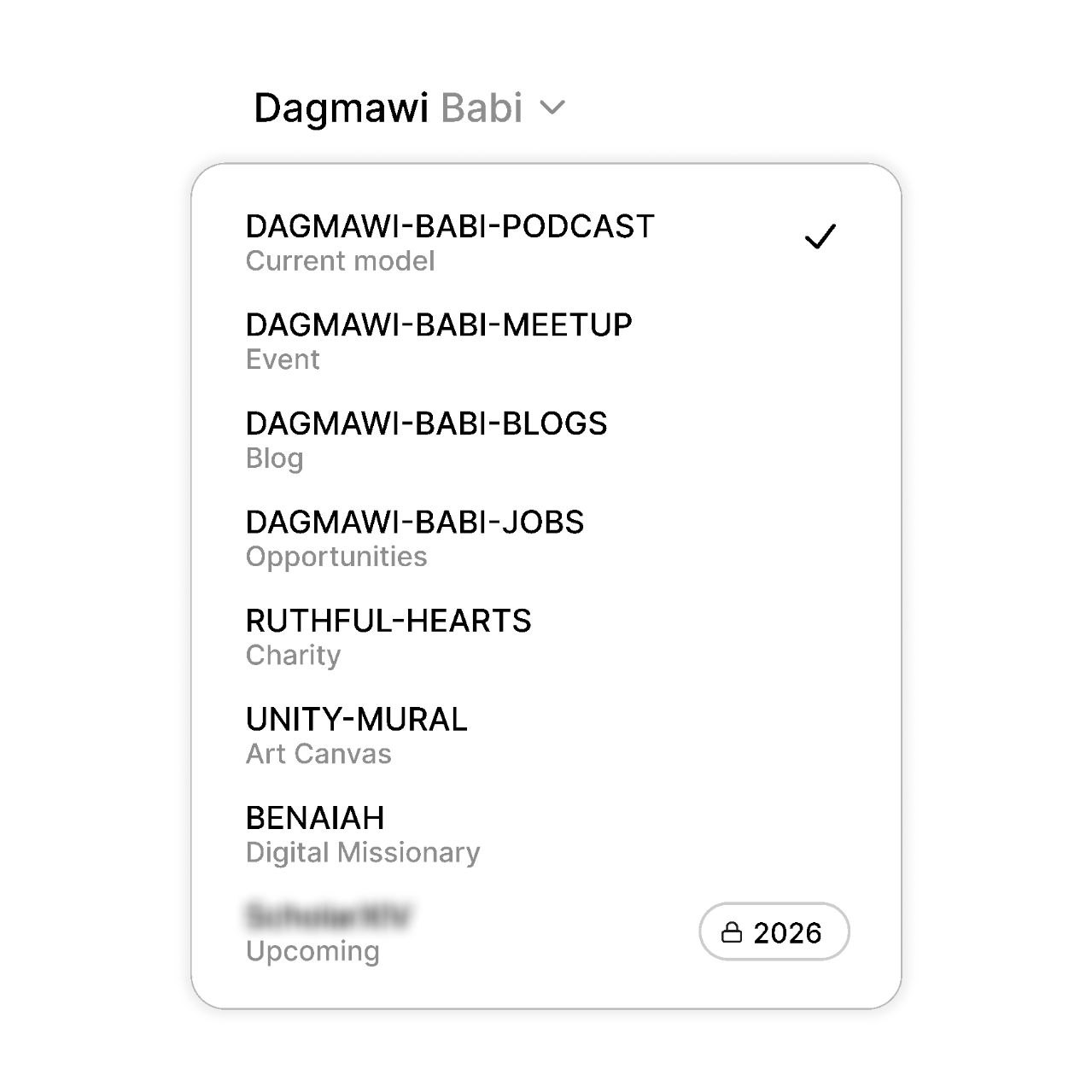
What’s the Dagmawi Babi Universe?
This’s just a fun way of calling the projects and initiatives I helped form or lead. So here they are:
- Dagmawi Babi — this’s my personal channel. Basically the start of it all.
- Dagmawi Babi Community — this’s my community
- Dagmawi Babi Podcast — this’s my YouTube channel. It’s where I post my podcasts, event content and more.
- Dagmawi Babi Jobs — this’s where I post events, job openings, internships and more opportunities
- Dagmawi Babi Meetup — this’s my yearly organized event for techies, designers and more
- DBlog — this’s my blog site
- Unity Mural — this’s the largest collaborative digital canvas for artists to showcase their digital arts
- Ruthful Hearts — this’s a community funded, anonymous charity led and managed by a group of incredible individuals. We fundraise once a year and spend the rest of the days donating it.
- Benaiah — this’s a digital Christian missionary organization run by amazing individuals to spread the good news of the gospel through written, visual and audio content.
I love all of these and I can’t wait for these to grow and be global.
How did you become a Christian?
I wrote my testimony in this detailed blog piece, check it out.
How do you manage your time?
This is arguably the most asked question for me. I get asked this in DMs, at events, from friends and family, on podcasts and more. I’ve been getting asked this since I was a sophomore in AASTU. So let’s get to it.
First off I’d like to make clear that I know I do a lot of things but I still feel like I can manage my time much better and I know there’s a lot to do cause there are days where I’m just lazy and waste my days on distractions and more. So I’ll just share my mindset and tooling.
Let’s start with the mindset: Time is a gift from God. A precious gift no one else can give you. You have to really understand that it’s out of God’s love and mercy you’re able to experience 24 hours a day, 7 days a week, 28-30 days a month and more. God provisioned these days for you, He also gave you the power to manage these days and do what you want with them.
Once you understand this, you should move to setting big goals in life. Something grand and impossible sounding. This is the hack to time management. If your goals are grand enough and drive you everyday then you’ll easily learn to manage time and other resources towards this. Apart from goals, priorities make time management easy. Get your priorities right, things you want to invest your mind, heart, and soul into and then you’ll see that somethings in your life don’t align with these priorities (aka they’re distractions) so you’ll have to start cutting these off.
On tooling, use a calendar app. I use Google Calendar. Fill your calendar with your routine tasks, work schedules, repetitive things like birthdays. This’s the first step but it’s a good step because you can see how many of your days are occupied by “life” and you’ll see how little days you’ve got to work on your goals and priorities. Then start adding in your priorities like “Spending time with my Family”, “Working on my side project”, “Learning this instrument”, “Bible Studying” and more. Now be loyal to your calendar. When people try to steer you away, when distraction happen, make sure you are loyal to your calendar. Then this consistency will translate to great time management before you know it.
I also suggest a todo and notes app. I use Notion and MinimaList (on Android). The idea of todo lists is to make you list important things to spend your hours on. When it comes to todo-s I am not strict. I write a list on the night prior and then spend the next day crossing them off. My idea is no matter what time of day or night it is, the list must end that day and a new list should be formed for the next one. I never box the tasks within hours cause I’ve never managed to get that right. But sorting them in priority helps a lot. Notebooks like Notion are great to manage your tasks well. You can take one task and then write details and subtasks about it. On your main todo list you can just say “Work on my side project” but in your notes you break that down to “add payment”, “add a database” and more.
Finally, and I say this with love! ditch people that waste time. You would assume that everyone wastes time but trust me there are really amazing people that genuinely manage their time and days better than me. So first step is for you to manage your time well, next one is to be surrounded by people that do this. This will make time management become your identity than a task and it will push you to be more effective with your time. Hope this helps.
How are you so consistent in content creating?
Ultimately it comes down to how you see content creating. If you see it as a task or something you have to do to land a job or then it’s very easy to lose momentum and stop. But the way I see my channel is as a public journal and archive. I post there simply so I can save it for later use or reference, that’s it. So when you see it that way I’m not really posting for people or for other reasons. I’m simply writing notes about the things I’ve learnt or discovered so I can revisit it later. So your perspective on how you see it really has power over your consistency. I would really recommend you read this piece I’ve written before to shift your mindset.
Another useful thing is resting. Posting for the sake of posting just degrades the quality of your content, it’s better to not post at that point. So set a resting or curfew system for yourself. Maybe you don’t post on weekends, maybe you post every other day, maybe you don’t post past midnight, maybe you take the whole of April off. Last two is what I do and found to help manage my energy and time very well.
Software Engineering in the age of AI
Let’s just jump into it, should a person learn software engineering seeing how advanced these AI tools are getting?
Understand that "Your Job as a software engineer isn't to write code, it's to deliver code you have proven to work.” (from a blog by Simon Willison What this simply means is that writing thousands of lines of code shouldn’t be how you compare yourself with AI, but instead the actual engineering, architecture and optimizations part of it. You just absolutely can’t write code as fast as an LLM can, but you definitely can come up with creative solutions to problems, architect and engineer them well and see them to completion.
So with this in mind Yes, you should learn how to program, how to manage programming tasks and related tasks. If you’re looking for a roadmap check this roadmap out. I recommend not using any AI during the early stages of your learning. Unless you’re able to manually build a full-stack project, heavy use of AI just makes you a lazy learner. But once you get to the point of comfortably building things manually, use AI to brain storm, to research, to analyze and write repetitive tasks.
I am an experienced developer but I get so overwhelmed by the progress of AI, what should I do? We’ve all felt it. I actually call it “AI Induced Depression” but don’t worry there are somethings you can do to get your chin back up. Avoid social media (like Twitter) for a while. Should a person spend everyday looking at ads? NO! That’s basically twitter. Every cool demo, or launch video you see is essentially marketing material for the product they’re selling and we’re consuming it. In-fact this’s such a great marketing scheme that YC and other accelerators started considering Twitter Hype as some kind of metrics to accept candidates. So avoid social for awhile.
Then, use an LLM. I recommend vibe-coding something using Lovable or v0. Push it to the maximum and get comfortable trying to see how far it can go, how well the code is written and just experience it first hand. Finally, start building an AI tool/project. AI-SDK by Vercel is a great starting point. Use that to build a ChatGPT clone or some other AI powered tool. You will instantly unlock a really creative side of your mind and you’ll actually feel much more excited and adventurous about AI. Hope this helps!
What AI tools do you use?
I am very interested in a lot of AI tools and apps. You’ll usually see me try a lot of things for research and exploration. I use AI for daily activities and also for coding related tasks and in those areas I have favorites. For day-to-day chats and interactions, I really like ChatGPT (obviously). It’s really nice, quick, available for free, remembers things, and I just like the app experience over all. I’ve always been a ChatGPT guy but in-terms of “AI personality” I really like GPT-5.4 alot. It’s got a very distinct tone and way of responding and I like it a lot. A part of me wishes Claude Opus 4.6 was as easily and freely available in Ethiopia but it’s not. Not sure but if Anthropic was as consumer friendly as OpenAI I might really like Opus 4.6 for daily interactions.
When it comes to coding there are two alternatives. One is a terminal based coding agent, the other is a GUI one. For a terminal based one, OpenCode is the one for me. Apart from having great DX and tools, they’re very generous with their limits and it’s a really nice experience. But I have completely moved to a GUI based coding agent, which is the Codex app. I made the switch almost overnight, it was just very comfortable to use and does things just right. I use a GUI based text-editor, it’s only fair I use a GUI based coding agent. The Codex model in on itself is just so incredible. I use it for work and it’s the only AI subscription I pay for.
I like vibe-coding sometimes. My number one vibe-coding tool is v0 by Vercel. Now and then, maybe when I’m bored or when I’m brainstorming I vibe-code, plus I’m a community representative of v0 for Addis Ababa so I got some credit to burn through (lol). v0 came out of the blue and became such an epic and unique vibe-coding platform. It’s powered by Opus 4.6 by default (at the time of writing this) and it’s just mind blowing. You should checkout the showcase section of my Vibe-coding blog and see all the impressive things me and people have built with it. One of the most defining features of v0 for me is the ability to import GitHub projects — which is amazing cause you can import any of your own projects or any open-source one and continue building on top of it. AND you can take that code away or deploy it on Vercel.
Whenever a new model drops, I use LM-Studio to experiment with it. LM-Studio is just perfect. You open it up either in your terminal, or server or in GUI and search up any model on huggingface, download it and get to experimenting. It’s got an incredible DX and gives you the ability to server models too which opens up doors for you to build things using that API.
When I want to train or fine-tune a model I use Prime Intellect's Labs platform. It's like the Vercel of AI traning. It's also so well built that you can literally "vibe-train" a model. It's really that good! When I want to benchmark a model I use Evalite — it's open-source with a very nice DX. You can checkout Enkokilish Bench to see how I do it.
What tech stack do you use?
Whenever I get asked this I don’t call out any tech stack and proceed to tell people to try out a few of the available ones, and just stick with whatever made them comfortable and made the path from idea to prototype quick.
But if you’re so keen in knowing my personal stack I’ll tell you. So I really like SvelteKit for web dev ALOT. When I’m building something in Svelte, I’m not thinking about Svelte at all, I’m fully locked in to the idea of what I’m building and that’s an amazing thing. For mobile apps I use Flutter. I’m big on Flutter with almost every complete app I’ve built and released is made by Flutter. I love the DX, nothing comes close to it even after all these years. I love the cross-platform abilities, the package ecosystem, the versatility, the community and the speed you go from idea to prototype is insane.
For APIs I really like HonoJS. It’s simple, it’s quick-setup, it comes with everything you need to get an API running in your server asap. For databases, I’m big on MongoDB. It gives me so much freedom when I’m designing relationships and later changing them, I love this about MongoDB. Plus MongoDB Atlas gives 512mb of storage for free which is enough for a-lot of side projects and can easily scale.
For other stuff I really love Python and Go. I have a special nostalgic relationship with Python — I basically studied the docs of Python and built SO MANY project when I discovered it in highschool. I was introduced to Go very recently compared to Python but I really enjoyed writing with it quickly after I got the hang of things. I really enjoy easily readable programming languages and Go is one of those. Plus it’s got similarities to Dart (in Flutter) for me and that makes the DX pretty nice.
I use Zed as my code-editor. The speed it opens up and loads files feels so good, I rarely wait for things to load across it’s functions. And for someone who came from Windsurf and VSCode the speed is crazy. A bit of a tangent but I believe with the right leadership Zed is going to be one of the most loves and powerful companies than Cursor-like ones. They’ve got every level of their stack built in-house and somehow caught up with Agentic Coding now. I’m rooting for them to beat these VS-Code forkies.
I am a big Firefox browser guy. I spent years on the basic Firefox browser and then switched to Firefox Developers Edition. But then Arc launched I dailyed that for a while. Then they stopped maintaining the browser, luckily though, Zen came! Zen is like Arc but so much better and also Firefox based! It's just beautiful and conveinient to use. It gets out of the way and lets you focus on the content you're browsing!
Aside from buying and spinning up my own VPS, I almost always deploy to Vercel. It’s just my default and I haven’t found any other service that’s as easy and comfortable to deploy to other than Vercel. Also whenever I’m building AI based projects I use Vercel’s AI Gateway for inference. It’s slightly more expensive than others but they make it up by giving you faster inference and the best DX. Not to mention you can pay in crypto even (lol) — also Vercel made AI-SDK which is the best AI package to build with.
Finally for project management and tracking I use a mix of Notion and Linear. I usually use both at the same time. I use Notion for personal use and have a project setup in Linear to work with others.
I have a project at hand, how much should I charge and how much time should I allocate to it?
Having a good understanding of the market price for programming tasks is good thing. For that you should talk to devs about salaries, contracts and whenever you can. It helps orient yourself properly in the market. Apart from that what I found to be so easy to price things is to just list the main features/components of what I’m building and then pricing each of them, finally adding it all up to a total sum. This usually works a lot and also it’s a nice way to communicate with your clients. Gives both of you freedom over the tasks and payment.
It’s equally important that the sum total of what you’re charging makes you feel good. Let’s say you’re charging 100k ETB for an app. Imagine the days and nights you’re going to spend writing code, testing on devices, submitting to app stores, and more and compare that effort to 100k ETB and does that feel good enough or is it too little or too high? This should help you land on a good and fair price.
Amount of time it takes differs from people to people and skill to skill, you’ve gotta be self-aware of your abilities and your use of tools. But general advice is to always pick a time that’s more extended than what you predict will take. If you predict the project will take a month, then state that it will take a month and two weeks at least. If you deliver before that, you’re a great dev; if you deliver on that timeline, you’re a punctual one. So always consider some extra time but aim to deliver much sooner.
What projects should I build to land a Job or stand out?
When starting off, almost everyone build todo apps, finance managers, and gym planners. Then people move on to clones — like YouTube, Amazon, Facebook clones. It’s fine to build these and you learn a lot from them. But why would anyone care about these? They’re just your own experiments to learn on. But if you want to stand out there are two things you can do. One, is to look around your own life and circle and find problems and solve them with software. Once you solves this problem well for yourself and circle share it around, keep improving it and this will really make you a wonderful dev. Two, is to look at a really ambitious project, something monumental or monopolistic enough that most people are afraid to take on — and then you take that on. This will make you stand out as the David to the Goliath.
A really good advice I’ve gotten earlier on is to finish what I’ve started. This’s such a wise advice honestly. You lunch more by completing a project than working on multiple incomplete ones. So whatever small or big thing you’re working on complete it. Completion here doesn’t mean always building the full product, it means to polish the current state, document it well and publish it. At the very minimum it should be functional and has a good GitHub readme guide. At the best end, it should be fully built and functional, documented well and published properly.
Once you’ve completed your projects don’t just bury them, show them to your family and friends, post them on your socials. Take feedback and iterate. Keep doing this and you’ll build a wonderful and trusted reputation. Sharing on your socials is a must, you have to do it! You’d be surprised by the amount of opportunities you’re going to unlock.
How to make money?
On this topic I have a bit of a radical view. My view is simple really, apart from your job and gigs, you have to give God the position of Providence over your life. This has worked for me. Jobs are never consistent, clients are never consistent. God’s providence is always consistent. So give God this position in your life and you’re going to be amazed at how well He’s going to deliver.
Look at the birds of the air; they do not sow or reap or store away in barns, and yet your heavenly Father feeds them. Are you not much more valuable than they?” — Matthew 6:26
Got More Questions?
Please checkout these podcasts I’ve been on if you wanna hear more about me or learn about somethings:
- Gugut Podcast EP#178
- Muya Podcast EP#12
- The Keb Tsegaye Podcast
- TechET Podcast S01EP01
- GDSC AASTU Podcast
- Tesfa Broadcasting Network
- Halak Podcast Part 1 and Part 2
- God Conscious Generation Podcast
Or send me a message on my channel DMs @Dagmawi_Babi